
All methanol is chemically identical. What differs is the carbon intensity (CI) assigned to each tonne based on the lifecycle pathway and the amount of qualifying CO₂ permanently stored.
EPCG offers two Lifecycle Carbon Intensity (CI)‑defined products
- Low‑Carbon Methanol (LCM)
CI Well to Wake (WtW): 74.3 gCO2eq/MJ (LR verified): using CCS equipped shuttle tankers
- ~28%/21% less than onshore ‘grey’/’blue’ methanol respectively
- ~19-22% (FEUM/IMO) less than traditional fuels
- ~3%-21% less than all LNG engine (energy converter) types
- Near‑zero (~2.5 gCO₂eq/MJ) when used as a chemical feedstock
- Enabling LCAF ~17% less than ICAO CORSIA base jet-fuel
Why it works:
- Produced from low‑carbon hydrogen
- Full CCS with permanent geological storage
- Avoids upstream emissions inherited by onshore plants
- Avoids onshore CO₂ disposal constraints
- Enables additional CO₂ from shipping (OCCS) or industry (IND CO₂) to be stored
Use cases:
- Marine and other fuels (lifecycle emission reductions)
- Chemical feedstock (near‑zero lifecycle emissions)
EPCG Methanol: Structural Decline in Lifecycle Carbon Intensity and Increase in CO₂ Storage
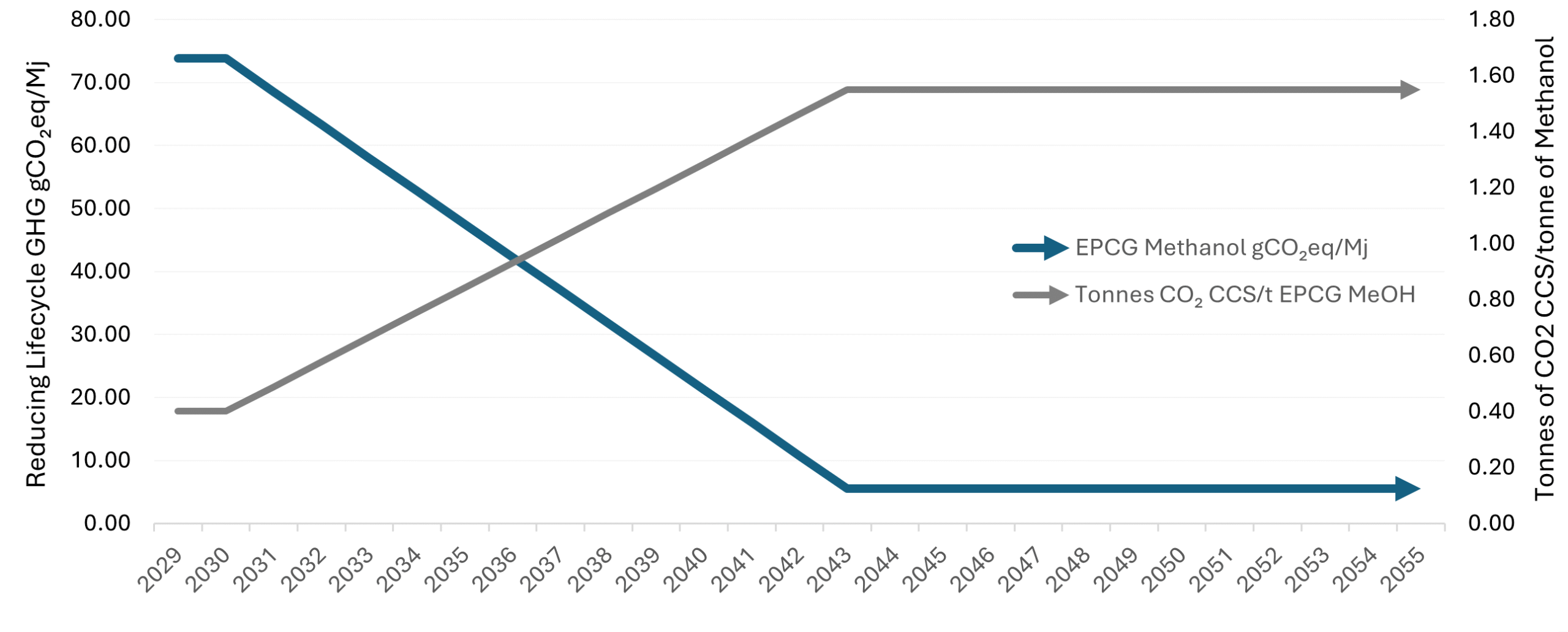 EPCG’s pathway structurally reduces lifecycle CI while increasing permanent CO₂ storage, enabling both LCM and ULCM products.
 - ~94% less than FuelEU Maritime Low Carbon Fuel Comparator (94 gCO₂eq/MJ)
- Negative CI: ~ – (minus) 65 gCO₂e/MJ as chemical feedstock
- Lower than bio‑methanol or e‑methanol
Why it works:
- Incorporates additional CO₂ from OCCS/IND CO₂
- Provides a scalable negative‑emissions feedstock
- Enables downstream producers to offset their own emissions
Use cases:
- Customers requiring maximum CI reduction
- Allocation of carbon intensity enabling customers to achieve a target CI (next section).
- Producers seeking negative‑emissions feedstock for polymers, chemicals, or fuels
EPCG methanol remains fully compliant with FuelEU Maritime and all plausible IMO NZF reduction trajectories through 2050.
The chart shows the declining lifecycle carbon intensity of EPCG methanol compared with FEUM maximum permissible values and IMO 2025 NZF proposed targets.
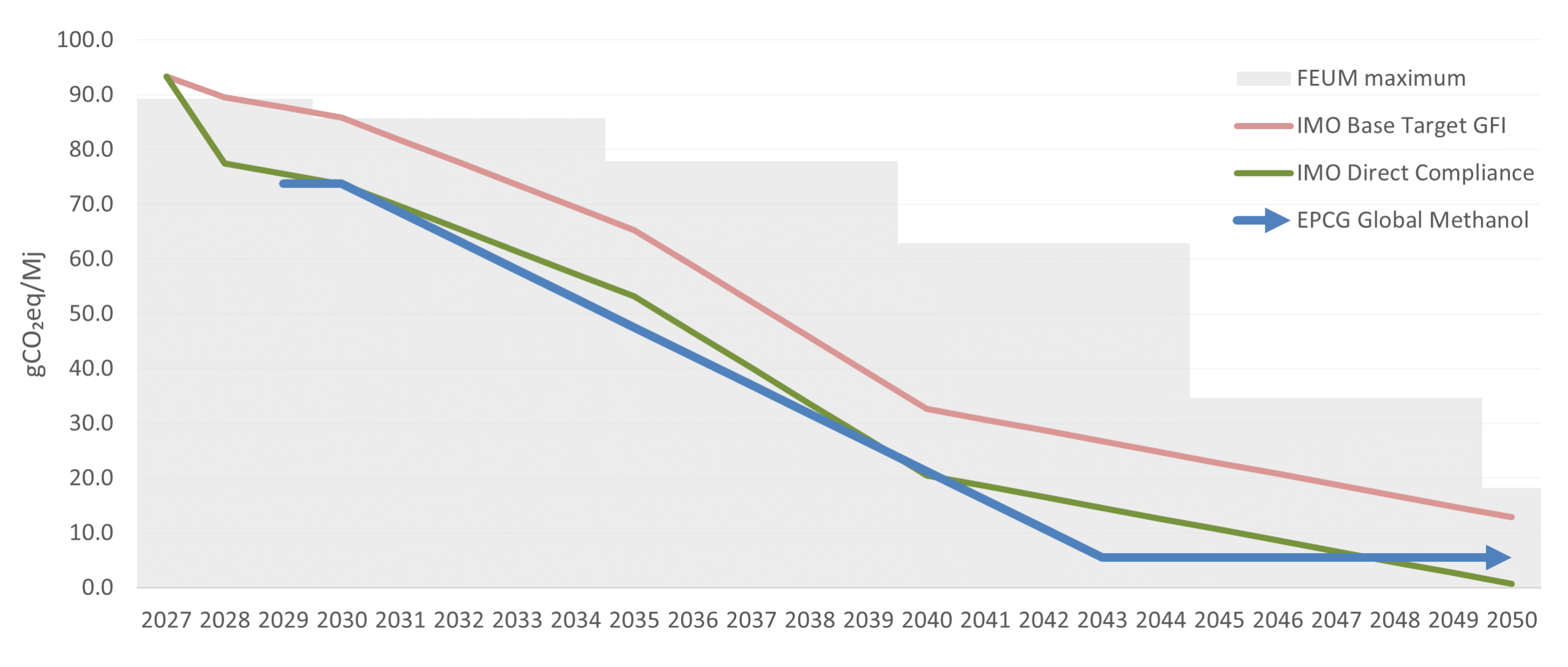
EPCG methanol remains below all FEUM and IMO NZF plausible trajectories through 2050. This structural advantage enables EPCG to allocate carbon intensity to customers based on their regulatory or commercial requirements.
Carbon Allocation & Blending Flexibility
Because methanol is chemically identical regardless of CI, EPCG can allocate carbon intensity to customers based on their regulatory or commercial needs.
Examples of customer‑driven allocation:
- European customers may request e.g. 70%-94% reduction to meet EU LCF requirements or blend with grey methanol or meet FuelEU Maritime trajectories.
- Global shipping customers may request e.g. 20-40% reduction aligned with IMO NZF trajectories.
- Chemical producers may request near‑zero or negative CI for feedstock use.
- Aviation customers may request specific CI values for LCAF feedstock.
How allocation works:
- EPCG ships the same physical methanol.
- CI is allocated through auditable lifecycle accounting, verified by Lloyd’s Register, with MRV reviewed and approved by the national statutory Regulator.
- Customers receive CI‑specific certificates aligned with FuelEU Maritime, EU ETS, ICAO CORSIA, and IMO frameworks.
- Allocation requires advance agreement to ensure correct CO₂ storage volumes are matched to contracted CI.
This flexibility allows EPCG to meet diverse regulatory regimes and customer strategies without changing the underlying product.
Contract Flexibility for Shipping & Industry
EPCG offers multiple commercial models for bunker methanol and chemical feedstock supply.
Fixed‑Price Supply Agreements
EPCG secures natural gas under long‑term fixed‑price contracts and is actively negotiating these across several diverse jurisdictions on this basis underpinning our sales pricing and options and can therefore offer similar benefits to customers:
- Stable, predictable fuel costs
- Long‑term budgeting certainty
- Independence from volatile fuel markets (methanol, HFO, VLSFO, MDO, LNG)
- Reduced need for hedging strategies
- Protection from price swings in other marine fuels
Typical terms:
- Long‑term fixed‑price contracts
- Delivered to customer – Delivered Customer Contract (DCC)
- Minimum agreed annual quantity
- Annual adjustment for inflation and tax changes only
- Delivery points agreed in advance
Indexed Pricing Agreements
For customers preferring market‑linked pricing, EPCG offers long‑term indexed contracts.
Index options include:
- Natural gas
- Global bunker fuel indices (e.g. IMO/Platts)
- Other indices or currencies agreed case-by-case
Pricing is customised based on:
- Volume commitments
- Contract duration
- Delivery port proximity to producing units
Regulatory Alignment & Independent Verification
Lloyd’s Register (LR) has independently verified that EPCG’s low‑carbon methanol:
- Complies with FuelEU Maritime from 2025 through 2050 due to:
- EU Delegated regulation for low-carbon fuels of 8.7.2025 and;
- EU ETS inclusion of shipping emissions from 2024 and;
- Correct handling of OCCS before and after 2041 (fossil‑sourced CO₂ until 2041, thereafter RFNBO, biofuel, or low‑carbon‑fuel CO₂)
EPC Global and LR have signed an MoU to support ongoing verification and regulatory compliance and further enhance EPC Global position as a leader in low-carbon methanol production.
Market Context
Methanol demand is growing rapidly, but supply of low‑carbon methanol is constrained by high production costs from other pathways (bio‑methanol, e‑methanol), meaning a growing market is not being fulfilled due to high pricing.
Cost-Competitive, Future-Ready
EPCG’s pathway provides:
- Cost‑competitive low‑carbon methanol
- Scalable negative‑emissions methanol
- Flexible CI allocation
- Long‑term price stability
- Compliance with global and regional frameworks
Summary
EPC Global’s Feedstock & Products offering provides:
- Flexible gas sourcing
- Two CI‑defined methanol products (LCM and ULCM)
- Carbon allocation tailored to customer needs
- Fixed‑price or indexed commercial models
- LR‑verified lifecycle accounting
- Compliance with IMO, EU, and ICAO frameworks
- Scalable supply for shipping, chemicals, and aviation